Levis Hipster Jeans: A Take-Apart Review
In this take-apart, I dissect Levis hipster jeans to examine the denim, stitching, and hardware. Is the low-rise hype justified? Read the full review.
I found a pair of Levis hipster jeans at a thrift store last month — $12, worn maybe three times. I brought them home and started taking them apart. These jeans have a reputation: low rise, tight fit, a cut that's been polarizing since they hit the market. But I wanted to see what the construction actually looks like. Are Levis hipster jeans built to last, or are they just a trend that happens to have a Levi's tag?
The Fabric and Hardware
First thing I noticed: the fabric. Levis hipster jeans use a 10 oz. denim — lighter than the classic 501's 12.5 oz. That makes sense for a slimmer cut; you don't want stiff denim bunching around the knees. The denim is sanforized, so minimal shrinkage. The weave is a twill, but the yarns feel a little loose — not the tight, dense feel of premium Japanese selvedge. The color is a classic medium rinse, with a slight sulfur-based indigo that fades to a blue-gray rather than a bright blue. There's a subtle slub in places, not consistent, but it adds some character. Still, for the price point (retail around $70-$90), it's a solid entry-level denim.
The hardware: a standard button fly with four buttons. The buttons are brass-coated, stamped with "Levi Strauss & Co. San Francisco." The rivets are copper, set with a slight domed head. I took one off to check the burr — it's a standard rolled rivet, not the old-school burr rivets you'd find on vintage Levis. Not a dealbreaker, but it tells me these were made for cost efficiency. The leather patch is thin stamped leather, decent but not the thick ones on premium lines. The care tag is a small cloth label sewn into the waistband — standard stuff.
Seam Construction and Fit
The stitching: the main seams are lockstitched, not chainstitched. That's typical for a budget jean; chainstitching is more expensive and less common on hipster-style jeans. The thread is a polyester-cotton blend, which is standard for strength, and the stitch count is about 8 stitches per inch — acceptable but not dense. The hems are lockstitched too, which means they won't roping like a chainstitch hem if you cuff them. The inseam is felled — a flat-felled seam, which is good for durability. The belt loops are attached with a bar tack at the top and bottom.
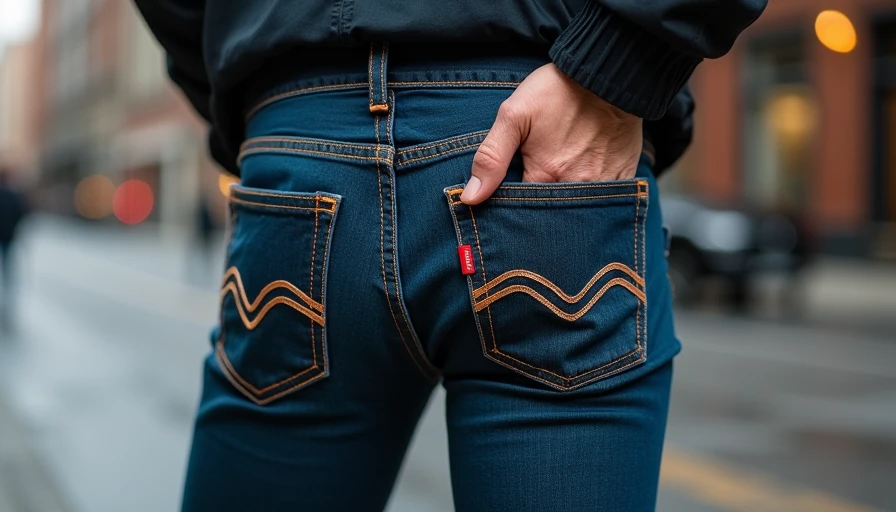
The pocket construction: the front pockets have a separate coin pocket on the right, standard. The pocket bags are cotton twill, not polyester — a plus. The back pockets have a simple stitch pattern: two parallel lines across the top, no embroidery. The pocket lining is the same denim as the body, which is nice. The fly is a button fly, not a zipper, with a reinforced buttonhole at the top and a bar tack at the bottom.
Now, the real test: the crotch seam. On slim jeans, crotch blowout is common. Levis hipster jeans have a double-needle lockstitch on the inside leg seam, and the gusset area is cut with a slight curve. There's a flat-felled seam at the crotch point, which adds strength. I'd still be careful about squatting in these, but they're better than some other slim jeans I've taken apart.
Let's talk fit: Levis hipster jeans are low rise, with a tight thigh and a narrow leg opening. That means they sit on the hips — some people love that look, others feel constricted. The rise measurement on this pair (size 32 waist) was about 8.5 inches front, 11 inches back. That's low. If you're used to a mid-rise, these will feel different. But the construction is consistent: the waistband is a single piece of denim folded over, with a fusible interlining to keep its shape. The waistband has a slight curve to accommodate the hips.
How Do They Compare to Other Levis?
I've taken apart 501s, 511s, and 514s. The 501 is a different animal — heavier denim, cinch back, chainstitch hems. The 511 is similar in cut but uses a slightly heavier denim (11 oz.) and often has a longer rise. The 514 is more relaxed. The Levis hipster jeans sit closest to the 511 in terms of cut, but with a lower rise and lighter weight denim. If you're used to 501s, the hipster will feel like a completely different pair of jeans — almost like a different brand. The 511 also has a more robust button fly, while the hipster's buttons are a bit smaller.
The Small Details
The small details reveal a lot. The buttonhole on the fly is reinforced with a bar tack at both ends — a sign of decent QC. The hem is a single-needle lockstitch, which means it won't roll when cuffed, but also means it's less durable than a chainstitch. The bartacks at stress points are tight and clean. The pocket corners are reinforced with a small triangle of stitching. The care label recommends washing inside out and line drying — standard for preserving denim.
Durability Expectations
Based on the construction, I'd expect these Levis hipster jeans to last 2-3 years of regular wear before any blowouts. The crotch area is the weakest point, as with most slim jeans. If you're hard on jeans, reinforce the crotch early. The denim will fade nicely over time, but the light weight means it won't develop high-contrast fades like heavyweight denim. For the price, they're a decent option if you're looking for a low-rise, slim cut that doesn't break the bank.
Verdict: Are They Worth It?
After taking them fully apart, here's what I found: Levis hipster jeans are decently made for their price. The denim is lightweight, the hardware is functional, and the seams are clean — not extraordinary, but not sloppy. They're not heirloom quality, but they'll hold up for a couple years of regular wear. The real question is whether the fit works for you.
If you're a 501 loyalist, the hipster will feel like a completely different pair of jeans. But if you want a low-rise, slim cut that doesn't fall apart in six months, these are a solid choice. Just don't expect them to develop the same fades as heavyweight denim.
Good things last. Bad things don't. These are somewhere in between.